RivetHub
Creator
2026 — present
Self-hosted · Apache 2.0 · no account
What it is
Every coding agent starts each session from zero. Claude Code doesn't know what Codex did an hour ago, and neither remembers last week. RivetHub keeps one record of what they all did, the prompts, tool calls, and results, on a machine you control. The next session, in any of them, picks up where the last one stopped.
It's the product side of RivetOS, the agent runtime I run at home. RivetOS does the capture and recall. RivetHub is the installers, the apps, and the UI for browsing everything your agents have done. Same repo, one product.
How it works
Capture. Sessions save themselves. As you work, each one lands in a Postgres store on your hub, from whichever supported tool you're in. Nothing to remember to write down.
Recall. Connected tools search the hub before they answer. A brand-new session in a different tool can find what was decided in another one. Full-text and fuzzy search work from the first session. Semantic search is optional: point it at an embedding endpoint you pick, local or cloud.
Source. Every hit opens the original conversation with its tool calls attached. Not a summary you have to trust. The actual exchange.
Ways to run it
Laptop. One installer for Linux or macOS sets up the hub, wires capture and recall into the supported tools it finds, and leaves you at a local web UI.
Data hub. Put the hub on a Debian or Ubuntu server and enroll agent machines over SSH. Every machine writes to and recalls from the same memory. You enroll what joins. Nothing phones home.
Rivet Cloud. Hosted memory at rivetos.cloud for people who'd rather not run a box. Your agents still run where they run today. You can export everything and leave.
The fastest setup is to hand it to the agent you already use: tell it to read rivethub.io/llms.txt and set up RivetHub on the machine.
The apps
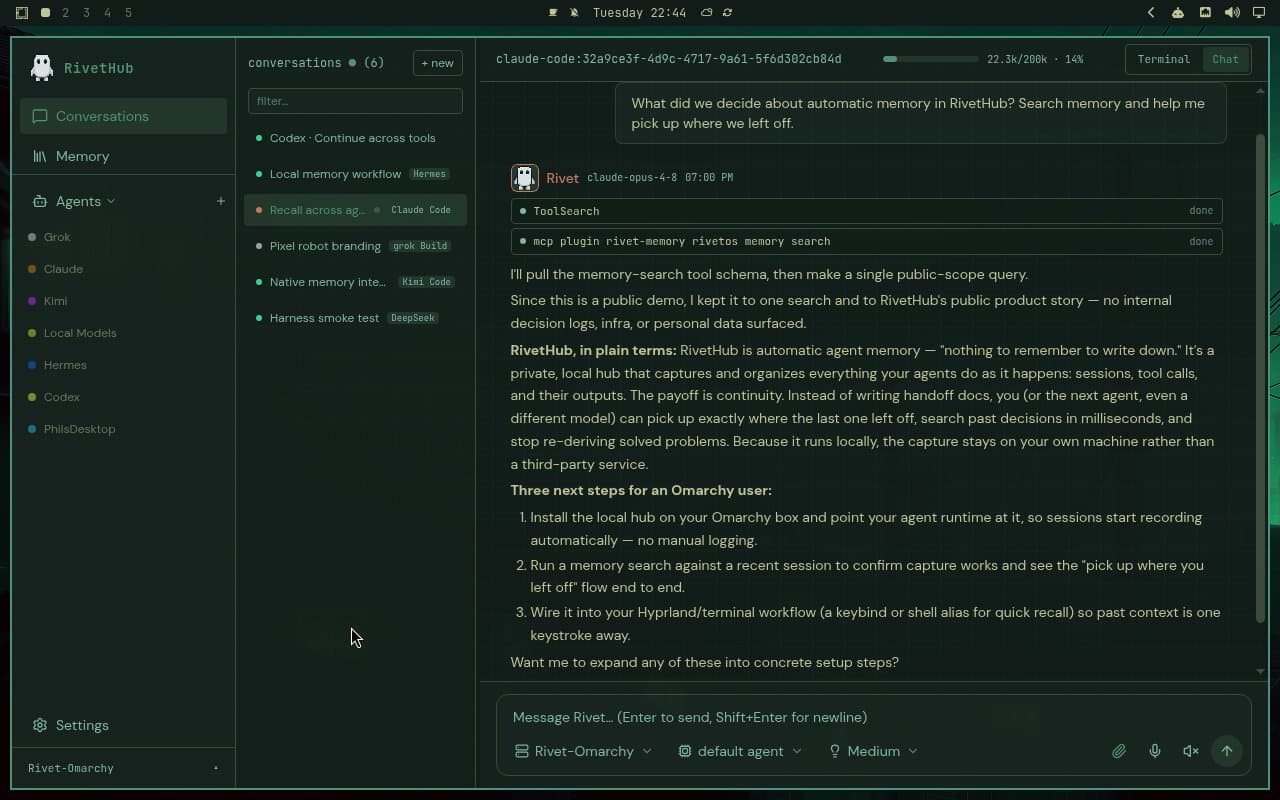
The desktop app is an Electron shell over the hub's web UI: conversations across every agent, memory search, a terminal view, and per-agent chat. On Omarchy it follows your desktop theme. The Android app pairs from Settings → Devices.
I use it every day. It's how Rivet keeps one memory across the Claude, Grok, Kimi, DeepSeek, GLM, and local agents in my lab, nearly a million messages so far.
Built in the open
RivetHub lives in philbert440/rivetOS, Apache 2.0. The clients, workflows, and a Rust runtime are growing in their own repos: rivethub-apps, rivethub-workflows, and rivethub-runtime. Most of the code is written by the agents it remembers for, and reviewed by other agents before it merges.
Site and install guides: rivethub.io. Docs: rivetos.dev.